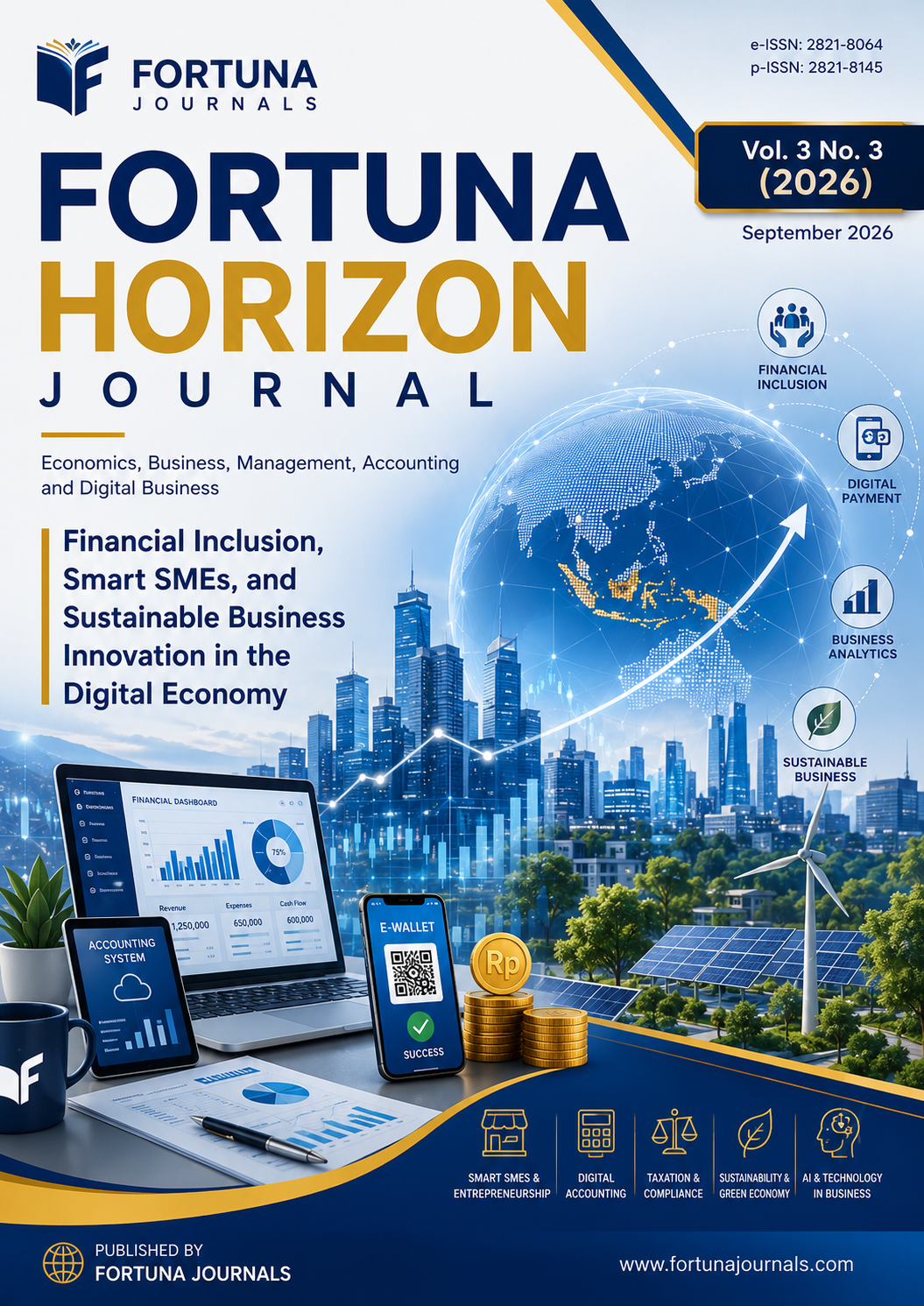
Vol 3, No 3 (2026): Financial Inclusion, Smart SMEs, and Sustainable Business Innovation in the Digital Economy
Issue Description
The rapid evolution of digital technology continues to reshape the economic landscape, creating new opportunities while presenting significant challenges for businesses, policymakers, and society. Small and Medium Enterprises (SMEs), as the backbone of Indonesia's economy, are increasingly required to adopt digital innovation, improve financial literacy, and strengthen organizational resilience to remain competitive in an interconnected global market.
This issue of Fortuna Horizon Journal (FHJ) explores how financial inclusion, digital transformation, accounting innovation, business sustainability, taxation, and strategic management contribute to building resilient and inclusive economic growth. It welcomes empirical studies, conceptual papers, literature reviews, and case studies that provide practical and theoretical insights into contemporary economic and business issues.
Special attention is given to research that integrates local wisdom with global perspectives, highlighting innovative practices capable of supporting sustainable development and digital economic transformation.
Topics of InterestAuthors are invited to submit manuscripts related to, but not limited to:
- Digital transformation in SMEs and entrepreneurship
- Financial inclusion and financial literacy
- Digital accounting and accounting information systems
- Tax policy, tax compliance, and digital taxation
- Sustainable business models and ESG implementation
- Green finance and sustainable investment
- Business strategy and organizational competitiveness
- Marketing innovation and consumer behavior
- Financial technology (FinTech) and digital payment systems
- Corporate governance and business ethics
- Artificial Intelligence in business decision making
- Business analytics and data-driven management
- Human resource management in the digital era
- Supply chain resilience and logistics management
- Banking and financial institution innovation
- Public sector accounting and financial governance
- Social entrepreneurship and community empowerment
- Business policy and economic development
- Local economic development and regional competitiveness
- Other interdisciplinary studies related to economics, management, accounting, taxation, finance, and digital business.